Background of the author
Salon interview with Sharon Olds
Some of Sharon Olds' thoughts:
"It's curious where different people think their mind is. I guess a lot of people believe that their mind is in their brain, in their head. To me, the mind seems to be spread out in the whole body — the senses are part of the brain. I guess they're not where the thinking is done. But poetry is so physical, the music of it and the movement of thought. Maybe we can use a metaphor for it, out of dance. I think for many years I was aware of the need, in dance and in life, to breathe deeply and to take in more air than we usually take in. I find a tendency in myself not to breathe very much. And certainly I have noticed, over the years, when dancing or when running, that ideas will come to my mind with the oxygen. Suddenly you're remembering something that you haven't thought of for years."
"I think that my work is easy to understand because I am not a thinker, I am not a . . . How can I put it? I write the way I perceive, I guess. It's not really simple, I don't think, but it's about ordinary things — feeling about things, about people. I'm not an intellectual, I'm not an abstract thinker. And I'm interested in ordinary life. So I think that our writing reflects us."
"There are some things that have to do with art that we can't control. This creature of the poem may assemble itself into a being with its own centrifugal force. That's what I'm thinking about when I'm trying to get out of art's way. Not trying to look good, if a poem's about me. Not trying to look bad. Not asking a poem to carry a lot of rocks in its pockets. But just being an ordinary observer and liver and feeler and letting the experience get through you onto the notebook with the pen, through the arm, out of the body, onto the page, without distortion. And there are so many ways I could distort. If I wrote in a sonnet form, I would be distorting. Or if I had some great new idea for line breaks and I used it in a poem, but it's really not right for that poem, but I wanted it, that would be distorting. It's kind of like ego in a way, egotism or narcissism. Where the self is too active."
"I don't know if it would feel accurate to me to say that I put myself into my poems. I don't know if that would describe what was happening in a poem that I wrote and that I liked. Someone is seeing, someone is thinking, dreaming, wondering, and remembering, in everybody's poems. Whether there's a speaker that has an explicit “I” or not, there is some kind of self or spirit or personality. . . . That's partly what craft is, I think. The body of the poem is the spirit of the poem. But I do sometimes make an effort to use the word “I” as little as possible. I would not have chosen to have that word appear so much in my poems. My poems — I don't even like the sound of that, in a way. Not that anyone else wrote them. But we know that only people who are really close to us care about our personal experience. Art is something else. It has something to do with wanting to be accurate about what we think and feel. To me the difference between the paper world and the flesh world is so great that I don't think we could put ourselves in our poems even if we wanted to."
Class Discussion Questions:
1. All of the poems we read have at least one characteristic in common: a first-person speaker. Yet Olds has said that her poems are only "apparently very personal"; what could she mean by this assertion?
2. In "Little Things," does the "duty to find things to love" reflect a duty to write poetry (as in "I Go Back to May 1937," the speaker says, "I will tell about it")? "Does it reflect a duty to read poetry?
3. How do you react to the open sexuality and graphic nature of "My Father Speaks to Me from the Dead?" Through whom does the father speak? What is "matter's love"?
4. What's the connection in "Adolescence" between a contraceptive device and the speaker's "own life"?
5. In "The Talkers," why does the speaker describe sentences as "delicate chains"?
6. "First Weeks" seems to be about two births; does this interpretation reflect an appropriate way to read the poem?
Showing posts with label authors. Show all posts
Showing posts with label authors. Show all posts
Tim O'Brien
Background of the author
Class Discussion Questions:
1. What is significant about the repeated use of "would" in the story "Speaking of Courage"? How does this word capture the feelings of the narrator about Norman and his problem?
2. Why couldn't the town talk, and why wouldn't the town listen? Whom does Norman tell his story?
3. What is the fine distinction that Norman would have made, if there were anyone to listen?
4. In "Notes," what fine line does Tim O'Brien draw to help explain the purpose of storytelling for him?
5. What is wrong with the original version of "Speaking of Courage"? Why does O'Brien say that HE is the one who almost won the Silver Star for valor, not Norman?
Class Discussion Questions:
1. What is significant about the repeated use of "would" in the story "Speaking of Courage"? How does this word capture the feelings of the narrator about Norman and his problem?
2. Why couldn't the town talk, and why wouldn't the town listen? Whom does Norman tell his story?
3. What is the fine distinction that Norman would have made, if there were anyone to listen?
4. In "Notes," what fine line does Tim O'Brien draw to help explain the purpose of storytelling for him?
5. What is wrong with the original version of "Speaking of Courage"? Why does O'Brien say that HE is the one who almost won the Silver Star for valor, not Norman?

Raymond Carver
Background of the author
Class Discussion Questions:
1. Who is the narrator of this story? Explain how you know. What motivates the narrator to tell this story in the first place?
2. How does the seeing man first try to help the blind man to "see" a cathedral? How do they later learn to "see" one together?
3. Why does the seeing man keep his eyes closed at the end of the story? Give an elaborate answer to explain your thinking.
4. Describing the style of writing that Carver helped develop, John Barth came up with "Post-Alcoholic Blue-Collar Minimalist Hyperrealism." Explain this category one word at a time. What is the significance of such an extended term, with so many different descriptors?
5. What is minimalism? How does a story like "Cathedral" manage to mean so much without saying very much?
Class Discussion Questions:
1. Who is the narrator of this story? Explain how you know. What motivates the narrator to tell this story in the first place?
2. How does the seeing man first try to help the blind man to "see" a cathedral? How do they later learn to "see" one together?
3. Why does the seeing man keep his eyes closed at the end of the story? Give an elaborate answer to explain your thinking.
4. Describing the style of writing that Carver helped develop, John Barth came up with "Post-Alcoholic Blue-Collar Minimalist Hyperrealism." Explain this category one word at a time. What is the significance of such an extended term, with so many different descriptors?
5. What is minimalism? How does a story like "Cathedral" manage to mean so much without saying very much?
Ann Beattie
Background of the author
"Where Characters Come From" by Ann Beattie
Like Updike's "Separating", Beattie's "Weekend" shows how intensely private and personal much of storytelling became in the second half of the 20th century. Both stories were written in the 70's, a period often associated with suburban angst and the steady disintegration of traditional family values. And both confront the pain of emotional loss with unflinching seriousness.
Class Discussion Questions:
1. In "Weekend," what chronic affliction does George have that bothers him periodically? Does this affliction have symbolic value, like in the O'Connor stories?
2. Why is Lenore so concerned with her daughter's imperfections?
3. What does Lenore show Julie to explain why she stays with George?
4. Describe Lenore's memory at the end of the story, when the narrator says, "She thinks of another time, when it was warm."
5. What allows Beattie to create such a gripping portrayal when the setting and characters are so familiar? I suppose we can ask again what Updike asked: is transcribing middleness "worth doing"?
"Where Characters Come From" by Ann Beattie
Like Updike's "Separating", Beattie's "Weekend" shows how intensely private and personal much of storytelling became in the second half of the 20th century. Both stories were written in the 70's, a period often associated with suburban angst and the steady disintegration of traditional family values. And both confront the pain of emotional loss with unflinching seriousness.
Class Discussion Questions:
1. In "Weekend," what chronic affliction does George have that bothers him periodically? Does this affliction have symbolic value, like in the O'Connor stories?
2. Why is Lenore so concerned with her daughter's imperfections?
3. What does Lenore show Julie to explain why she stays with George?
4. Describe Lenore's memory at the end of the story, when the narrator says, "She thinks of another time, when it was warm."
5. What allows Beattie to create such a gripping portrayal when the setting and characters are so familiar? I suppose we can ask again what Updike asked: is transcribing middleness "worth doing"?
John Updike
Background of the author
Class Discussion Questions:
First, think about what John Updike has written about his artistic intentions:
from "The Dogwood Tree: A Boyhood" (1962)
He once said his aim was "to give the mundane its beautiful due."
"Blankness is not emptiness; we may skate upon an intense radiance we do not see because we see nothing else. And in fact there is a colour, a quiet but tireless goodness that things at rest, like a brick wall or a small stone, seem to affirm."
"To transcribe middleness with all its grits, bumps, and anonymities, in its fullness of satisfaction and mystery: is it possible or, in view of the suffering that violently colors the periphery and that at all moments threatens to move into the center, worth doing? Possibly not; but the horse-chestnut trees, the telephone poles, the porches, the green hedges recede to a calm point that in my subjective geography is still the center of the world."
1. Judging from the story we read, "Separating," is transcribing middleness "worth doing"? What does Updike mean by "periphery" and "center" when talking about suffering?
2. How can the intention to leave and the overwhelming urge to cry coexist in Richard? Consider both extremes and where they intersect.
3. Why does this story work so well in third-person, even though almost all of the details are meant to give us Richard's point of view?
4. Why is the question "Why?" left unanswered at the end of the story?
Class Discussion Questions:
First, think about what John Updike has written about his artistic intentions:
from "The Dogwood Tree: A Boyhood" (1962)
He once said his aim was "to give the mundane its beautiful due."
"Blankness is not emptiness; we may skate upon an intense radiance we do not see because we see nothing else. And in fact there is a colour, a quiet but tireless goodness that things at rest, like a brick wall or a small stone, seem to affirm."
"To transcribe middleness with all its grits, bumps, and anonymities, in its fullness of satisfaction and mystery: is it possible or, in view of the suffering that violently colors the periphery and that at all moments threatens to move into the center, worth doing? Possibly not; but the horse-chestnut trees, the telephone poles, the porches, the green hedges recede to a calm point that in my subjective geography is still the center of the world."
1. Judging from the story we read, "Separating," is transcribing middleness "worth doing"? What does Updike mean by "periphery" and "center" when talking about suffering?
2. How can the intention to leave and the overwhelming urge to cry coexist in Richard? Consider both extremes and where they intersect.
3. Why does this story work so well in third-person, even though almost all of the details are meant to give us Richard's point of view?
4. Why is the question "Why?" left unanswered at the end of the story?
Denise Levertov
Background of the author
Class Discussion Questions:
1. The speaker in "To the Snake" swears to her companions that the green snake was "harmless," but what is her motivation for holding it, to feel its "weight"?
2. What is the "dark morning"?
3. In "The Jacob's Ladder," explain the last line. How does "the poem" ascend? What about the poet?
4. In "In Mind," what is the crucial difference between the two women in the speaker's mind. Does the poem suggest that one is preferred?
5. How does Levertov explore the intersection between art and life in these poems? Are "art" and "life" conflicting or complementary terms?
Class Discussion Questions:
1. The speaker in "To the Snake" swears to her companions that the green snake was "harmless," but what is her motivation for holding it, to feel its "weight"?
2. What is the "dark morning"?
3. In "The Jacob's Ladder," explain the last line. How does "the poem" ascend? What about the poet?
4. In "In Mind," what is the crucial difference between the two women in the speaker's mind. Does the poem suggest that one is preferred?
5. How does Levertov explore the intersection between art and life in these poems? Are "art" and "life" conflicting or complementary terms?
Grace Paley
Background of the author
Class Discussion Questions:
1. What does the narrator mean when she says that "Everyone, real or invented, deserves the open destiny of life" (387)? What does this idea have to do with storytelling?
2. Who is the "stubborn hero" with whom the author must reach agreement in this story (388)? Who is the protagonist in the finished story WE are reading?
3. Why can't the father in the story see beyond the ending of the story his daughter writes, even though she insists that her character could change (390)?
4. How does Paley explore the intersection between art and life in this story? Are "art" and "life" conflicting or complementary terms (390)?
Class Discussion Questions:
1. What does the narrator mean when she says that "Everyone, real or invented, deserves the open destiny of life" (387)? What does this idea have to do with storytelling?
2. Who is the "stubborn hero" with whom the author must reach agreement in this story (388)? Who is the protagonist in the finished story WE are reading?
3. Why can't the father in the story see beyond the ending of the story his daughter writes, even though she insists that her character could change (390)?
4. How does Paley explore the intersection between art and life in this story? Are "art" and "life" conflicting or complementary terms (390)?
Flannery O'Connor
Background of the author
Class Discussion Questions:
"The Life You Save May Be Your Own"
1. How do you respond to the ending of this story? Is it a proper ending? What do you think motivated O'Connor to end the story with so little resolution, or is there resolution?
2. How does the ending change the otherwise simple sequence of events in the story? How does O'Connor create the added layers of complexity?
3. Besides not knowing what will happen next, how would you characterize the mysterious quality of this story? WHERE does O'Connor place the mystery; in other words, where does O'Connor expect us to find the mystery?
4. What do we experience in reading this story, even if we cannot "figure out" what it definitely means? Look beyond frustration here. What is the ethical benefit of our being perplexed? Think of what Tom T. Shiftlet says about the heart surgeon: "Why, if he was to take that knife and cut into every corner of it, he still wouldn't know no more than you or me. What you want to bet?" (438).
"Good Country People"
1. At the beginning of "Good Country People," the narrator describes Mrs. Freeman like a vehicle that travels down the road: "Her eyes never swerved to left or right but turned as the story turned as if they followed a yellow line down the center of it." Is this how O'Connor wants us to read her story? What does it mean to follow a "yellow line down the center of it"?
2. Where in the narrative do the primary events of this story actually first emerge in the telling? Why such a long build-up?
3. What are the afflictions in this story? In what way does Joy-Hulga's particular affliction(s) actually create the violent situation through which she might be healed?
4. What is an epiphany? Where does the epiphany occur in this story? What type of irony is used in a story when an epiphany occurs?
5. "True genius can get an idea across even to an inferior mind." Whose thought is this? How might the reader be the one with an inferior mind?
Class Discussion Questions:
"The Life You Save May Be Your Own"
1. How do you respond to the ending of this story? Is it a proper ending? What do you think motivated O'Connor to end the story with so little resolution, or is there resolution?
2. How does the ending change the otherwise simple sequence of events in the story? How does O'Connor create the added layers of complexity?
3. Besides not knowing what will happen next, how would you characterize the mysterious quality of this story? WHERE does O'Connor place the mystery; in other words, where does O'Connor expect us to find the mystery?
4. What do we experience in reading this story, even if we cannot "figure out" what it definitely means? Look beyond frustration here. What is the ethical benefit of our being perplexed? Think of what Tom T. Shiftlet says about the heart surgeon: "Why, if he was to take that knife and cut into every corner of it, he still wouldn't know no more than you or me. What you want to bet?" (438).
"Good Country People"
1. At the beginning of "Good Country People," the narrator describes Mrs. Freeman like a vehicle that travels down the road: "Her eyes never swerved to left or right but turned as the story turned as if they followed a yellow line down the center of it." Is this how O'Connor wants us to read her story? What does it mean to follow a "yellow line down the center of it"?
2. Where in the narrative do the primary events of this story actually first emerge in the telling? Why such a long build-up?
3. What are the afflictions in this story? In what way does Joy-Hulga's particular affliction(s) actually create the violent situation through which she might be healed?
4. What is an epiphany? Where does the epiphany occur in this story? What type of irony is used in a story when an epiphany occurs?
5. "True genius can get an idea across even to an inferior mind." Whose thought is this? How might the reader be the one with an inferior mind?
Ernest Hemingway

Interview with Hemingway
Iceberg Principle
Class Discussion Questions:
1. Where in the narrative do we know for sure what is wrong with the man’s leg? Look for the moment. Then ask yourself, "Why don’t we know right away?"
2. How does this medical problem develop? Explain the cause.
3. What activity has the man always put off for a later time and now realizes he no longer can find the will to do? Find all the references to this activity.
4. What is the relationship between the man and the woman based on?
5. Although the narrator of this short story does seem tied to the point of view of a single character, how is that point of view unstable?
6. What do you think is going on in present time during the first italicized passage? Why does the author split the narrative in this way? Answer these two questions separately.
7. How does the mixture of past and present events demonstrate the distinction between plot and story, and how does this mixture help us see how the man deals with his impending death?
8. The man at one point says, "'I want to write,'" (836) and later says, "'I've been writing. But I got tired'" (840). What can he mean by these admissions?
9. Does it become clearer, as the story progresses, what the man in doing in his mind during the italicized passages? The narrator: "There wasn't time, of course, although it seemed as though it telescoped so that you might put it all into one paragraph if you could get it right" (836). Does Harry ever "get it right" and "put it all into one paragraph"?
10. What is the iceberg principle? What is the justification for following it?
Narrative map for "The Snows of Kilimanjaro":
- 826: Story begins with Harry lying on a cot in Africa--in the middle of a conversation
- 827: Conversation escalates into argument and Harry starts to drink
- 827: First breakaway to thought: "So now it was all over, he thought."
- 828: Comes out of it, probably drunk now, and insults/abuses Helen, continues to drink
- 828: Second breakaway to thought, first time in italics: "Now in his mind . . ." various images and memories associated with snow and Christmas
- 830: Comes out of it, asking about Paris, "now, in Africa"--the quarrel continues, and then sleep
- 830: Third breakaway to thought, not in italics:Alone after a long nap, but now more alert--thinks through his own downfall and hers, what brought them together.
- 833: Comes out of it, and once Helen returns from hunting, and they both slip back into the lie. And finally, "it occurred to him that he was going to die"--happy the quarreling is over at least: "he wore it all out."
- 834: Fourth breakaway to thought, second italics: Helen goes to bath, thinks more about what he could have written, his duty to do so.
- 836: Comes out of it, and says, "I want to write," suggesting that during the italicized passages, he has been doing something else. "I'm going to die tonight"--knows he's running out of time.
- 836: Fifth breakaway to thought, third italics: longest section, multiple attempts to write out stories, but still in his mind.
- 838: Comes out of it, just to ask for a drink.
- 838: Sixth breakaway to thought, fourth italics: shorter this time, two different ideas for stories he could have written.
- 839: Comes out of the italics but not back to the surface: "You tell them why" is a direct response to the question "Why?" in the italics. . . as if Harry on the cot and Harry in his mind are not the same person. Sort of stays in thought before . . .
- 840: Fifth italics: Williamson, pain, and death. The perfect paragraph . . . "There wasn't time, of course, although it seemed as though it telescoped so that you might put it all into one paragraph if you could get it right." It is a self-contained story, no commentary.
- 840: Comes out, still thinking about pain and death coming. And then back to the present again: "I've been writing. . . . But I got tired."
- 841: Second to last section: The rescue, the morning after, or at least that is one way to put it.
- 842: Final section: Still night, actually.
Hemingway on Endings and Rewriting
From The Paris Review, no. 18 (1958), interviewed by George Plimpton
INTERVIEWER
Do you do any rewriting as you read up to the place you left off the day before? Or does that come later, when the whole is finished?
HEMINGWAY
I always rewrite each day up to the point where I stopped. When it is all finished, naturally you go over it. You get another chance to correct and rewrite when someone else types it, and you see it clean in type. The last chance is in the proofs. You’re grateful for these different chances.
INTERVIEWER
How much rewriting do you do?
HEMINGWAY
It depends. I rewrote the ending to Farewell to Arms, the last page of it, thirty-nine times before I was satisfied.
INTERVIEWER
Was there some technical problem there? What was it that had stumped you?
HEMINGWAY
Getting the words right.
William Faulkner

Class Discussion Questions:
1. In "Barn Burning," the narrator of this story uses an immense vocabulary. Look for some particularly heavy expressions that he uses to describe the feelings and observations of the boy. Write them down and then define them.
2. What does this vocabulary tell us about the narrator? What does it tell us about the boy?
3. What is the point of view of the narrator on the story? How can he know the present, past, and future of the boy?
4. The second time we see the father in front of a Justice of the Peace, he says to his boy, "Go back to the wagon." Why does he have to disobey and stay?
5. Explain the boy's mixed attitude toward his father. Is it as simple as loyalty vs. justice?
6. Explain the last line of the story: "He did not look back."
F. Scott Fitzgerald

Background of the author
Class Discussion Questions:
1. The narrator tells us that Charlie "believed in character. He wanted to jump back a whole generation and trust in character again as the eternally valuable element. Everything else wore out" (678). What is "character," as the term is used in this passage? How does one trust in character, in this sense?
2. Find some other quotes in the story that address this idea of character (677, 678, 679, 680-81, 682, 683, 684, 687, 689).
3. What does the word "dissipate" mean to Charlie? Look for this moment in the story and mark it! It points to a key idea in the Modernist approach to telling stories.
4. How does Marion define "character"? How does her definition affect the outcome of Charlie's attempt to regain custody of his daughter?
T.S. Eliot
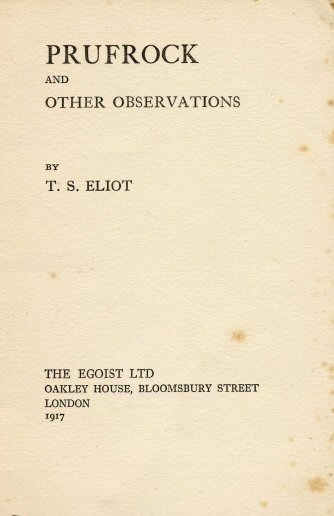
Read "Tradition and the Individual Talent"
Read "Hamlet and His Problems"
Background of the author
Read about "The Love Song of J. Alfred Prufrock"
Read about "Tradition and the Individual Talent"
Read about "Hamlet and His Problems"
Audio:
Eliot reading as a younger man?
Eliot reading as an older man?
Eliot reading with animated words
Translation of epigraph:
The epigraph comes from Dante's Inferno, Canto 27, lines 61-66. The words are spoken by one Guido da Montefeltro, who has been consigned to a suit of flame in the eighth circle of Hell as punishment for giving false counsel. He is, essentially, a liar, one who withholds or obscures the truth for personal gain at the cost of others. Interestingly, the famous literary hero Ulysses is also there, trapped in his own suit of flame for the same sin: he convinced his crew, after they had all safely returned home from war, to venture back out into open sea to look for more adventure. The ship was ultimately destroyed in a storm, and they all drowned. Here is the translation:
If I believed that my reply were made
to one who could ever climb to the world again,
this flame would shake no more. But since no shade
ever returned—if what I am told is true—
from this blind world into the living light,
without fear of dishonor I answer you.
The presence of this epigraph, followed by the ambiguous "then" in the first line of the poem, suggests that Prufrock is (a) a false counselor himself, (b) the Dantean poet who has returned from Hell to report back to us, or (c) some combination of both. Consider the last word of the poem--is Prufrock the anti-hero who invites us on a journey that ends in death?
Class Discussion Questions:
1. We are going to listen to T.S. Eliot read his own poem. As you listen and read along, I would like you to mark your text when you notice the following:
- repeated phrase or rhythm
- metaphors that capture an emotion
- signs of communication breakdown
- evidence of the speaker's self-consciousness
3. Identify some words in the poem that suggest the act of writing itself. Why would this speaker use these kinds of words in a "love song"?
4. If the speaker of this poem, Prufrock, is leading us on a journey, what kind of journey is it?
"Tradition and the Individual Talent"
5. What does Eliot mean by "No poet, no artist of any art, has his complete meaning alone"? How does the "historical sense" relate to being part of a bigger collection of meaning?
6. What is the catalyst analogy that Eliot explains and how does it relate to the impersonal theory of poetry (see beginning of Part II)?
7. What kind of emotion does Eliot want to see in poetry? How can the poet achieve this kind of emotion?
8. How can a poet be new and traditional at the same time? What does Eliot mean by "new"?
"Hamlet and His Problems"
9. What is an "objective correlative"?
Significant terms from the prose
- Impersonal theory of poetry
- historical sense
- catalyst metaphor
- "make it new"
- objective correlative
Wallace Stevens
Background of the author
Class Discussion Questions:
1. What is "a mind of winter" and why must one have it? Follow the syntax of "The Snow Man"--how many sentences does it contain? What are the primary actions in the poem?
2. How does "Thirteen Ways of Looking at a Blackbird" show the relationship between the mind of the poet and the creation of meaning? Does this speaker "behold nothing that is not there"?
3. In what ways is "The Death of a Soldier" a good example of finding what will suffice? What would the alternative be to finding what will suffice? Why does the speaker tell us what the soldier "does not become"?
4. What does the speaker in "Of Modern Poetry" mean by "the act of finding what will suffice"? Why must modern poetry produce "the poem of the mind"? What can the mind do?
5. What is the role of the imagination in "The Plain Sense of Things"? What is the "fantastic effort" that has failed?
6. How is "finding what will suffice" different from the "work of the imagination"?
7. How does "Poetry and Meaning" demonstrate the Modernist preoccupation with meaning?
Class Discussion Questions:
1. What is "a mind of winter" and why must one have it? Follow the syntax of "The Snow Man"--how many sentences does it contain? What are the primary actions in the poem?
2. How does "Thirteen Ways of Looking at a Blackbird" show the relationship between the mind of the poet and the creation of meaning? Does this speaker "behold nothing that is not there"?
3. In what ways is "The Death of a Soldier" a good example of finding what will suffice? What would the alternative be to finding what will suffice? Why does the speaker tell us what the soldier "does not become"?
4. What does the speaker in "Of Modern Poetry" mean by "the act of finding what will suffice"? Why must modern poetry produce "the poem of the mind"? What can the mind do?
5. What is the role of the imagination in "The Plain Sense of Things"? What is the "fantastic effort" that has failed?
6. How is "finding what will suffice" different from the "work of the imagination"?
7. How does "Poetry and Meaning" demonstrate the Modernist preoccupation with meaning?
Robert Frost
Background of the author
Class Discussion Questions:
1. How would you describe the tone of voice of the speakers in the poems you read for today? Identify the tone or attitude of the speaker in "Birches" and "Mending Wall" and then compare them to "Out, Out—" and "Fire and Ice."
2. In "Mending Wall," look for where the language visually represents the theme of the poem. Can you find it in the shape of the lines? Once you've found it, consider why Frost would use this technique.
3. In "Birches," the speaker gets off track and comes back to his point: "But I was going to say when Truth broke in / With all her matter of fact about the ice storm . . ." How would you characterize this kind of honesty? How is it different from Whitman's type of honesty?
4. Frost is an ACCESSIBLE poet in a way that other poets we read are not. What is the ethical value of his accessibility to you? What is accessibility?
5. What does Robert Frost mean when he says that a poem can be “a momentary stay against confusion”? What IS the figure a poem makes? And what is Frost's concern in explaining this figure?
Class Discussion Questions:
1. How would you describe the tone of voice of the speakers in the poems you read for today? Identify the tone or attitude of the speaker in "Birches" and "Mending Wall" and then compare them to "Out, Out—" and "Fire and Ice."
2. In "Mending Wall," look for where the language visually represents the theme of the poem. Can you find it in the shape of the lines? Once you've found it, consider why Frost would use this technique.
3. In "Birches," the speaker gets off track and comes back to his point: "But I was going to say when Truth broke in / With all her matter of fact about the ice storm . . ." How would you characterize this kind of honesty? How is it different from Whitman's type of honesty?
4. Frost is an ACCESSIBLE poet in a way that other poets we read are not. What is the ethical value of his accessibility to you? What is accessibility?
5. What does Robert Frost mean when he says that a poem can be “a momentary stay against confusion”? What IS the figure a poem makes? And what is Frost's concern in explaining this figure?
Charlotte Perkins Gilman
Background of the author
Class Discussion Questions:
1. Who is the narrator of this story? Look for references to “writing” in the narrative—what is the definition of “writing” in this story?
2. Can you account for the shape and appearance of this narrative? What is the resemblance between the wall-paper in the room and the narrative on the page?
3. Is “The Yellow Wall-paper” a proper “story”? How not? How so? Does it have a “plot”? Describe it.
4. Who is the woman behind the wall-paper?
5. According to the essay she wrote about “The Yellow Wall-paper,” what was Gilman’s ultimate purpose for writing that story? How does the story achieve this purpose?
Class Discussion Questions:
1. Who is the narrator of this story? Look for references to “writing” in the narrative—what is the definition of “writing” in this story?
2. Can you account for the shape and appearance of this narrative? What is the resemblance between the wall-paper in the room and the narrative on the page?
3. Is “The Yellow Wall-paper” a proper “story”? How not? How so? Does it have a “plot”? Describe it.
4. Who is the woman behind the wall-paper?
5. According to the essay she wrote about “The Yellow Wall-paper,” what was Gilman’s ultimate purpose for writing that story? How does the story achieve this purpose?
Jack London
Background of the author
Class Discussion Questions:
1. Unlike the narrator in "The Open Boat," the narrator of this survival story is difficult to identify with any certainty because neither the man nor the dog is capable of reporting what happens "after the fact," and yet the narrator seems to have intimate knowledge of exactly what happens, why it happens, and what each character is thinking as it happens. If we cannot ask "who," then what kind of narrator is telling this story? What point(s) of view or attitudes does the narrator have?
2. Compare the "knowledge" of the man and the dog. How does the narrator know that "Its instinct told it a truer tale than was told to the man by the man's judgment"?
3. Identify a moment where the narrator seems to know something the man does not know. Then identify a moment where narrator seems directly in sync with the sensory experience of the man. How do these two extremes help create the Naturalist tone of the story?
4. In light of the narrator's strategies, reflect on your involvement as a READER in what happens to the man. Are you sympathetic, apathetic, annoyed, etc.? How do you account for your response in the WAY the story is TOLD? Does the man change by the end?
5. What is the conflict in "To Build a Fire"? Remember, a conflict exists between two things. How is this conflict expressed in the story?
6. In what way does the essay "What Life Means to Me" make Jack London seem more idealistic than he seems as the author in "To Build a Fire"?
7. Does Jack London sympathize with human suffering? How does this sympathy relate to being a Naturalist?
8. What is the value of THINKING, as opposed to merely observing or reacting?
Class Discussion Questions:
1. Unlike the narrator in "The Open Boat," the narrator of this survival story is difficult to identify with any certainty because neither the man nor the dog is capable of reporting what happens "after the fact," and yet the narrator seems to have intimate knowledge of exactly what happens, why it happens, and what each character is thinking as it happens. If we cannot ask "who," then what kind of narrator is telling this story? What point(s) of view or attitudes does the narrator have?
2. Compare the "knowledge" of the man and the dog. How does the narrator know that "Its instinct told it a truer tale than was told to the man by the man's judgment"?
3. Identify a moment where the narrator seems to know something the man does not know. Then identify a moment where narrator seems directly in sync with the sensory experience of the man. How do these two extremes help create the Naturalist tone of the story?
4. In light of the narrator's strategies, reflect on your involvement as a READER in what happens to the man. Are you sympathetic, apathetic, annoyed, etc.? How do you account for your response in the WAY the story is TOLD? Does the man change by the end?
5. What is the conflict in "To Build a Fire"? Remember, a conflict exists between two things. How is this conflict expressed in the story?
6. In what way does the essay "What Life Means to Me" make Jack London seem more idealistic than he seems as the author in "To Build a Fire"?
7. Does Jack London sympathize with human suffering? How does this sympathy relate to being a Naturalist?
8. What is the value of THINKING, as opposed to merely observing or reacting?
Stephen Crane
Background of the author
Class Discussion Questions:
1. Look at the epigraph for the story. What is the significance of "after the fact" and "experience" in relation to how this story is told? What kind of narrator is telling this story? Find examples in the text that represent the characteristics of the narrator.
2. Look for subjective descriptions of nature and other, more general subjective statements. Find some quotes that show the attitude of the narrator toward the sea and the waves, and his predicament. Can his interpretation be described as an accurate one?
3. What is the nature of the conflict in "The Open Boat"? Remember, a conflict exists between two things. How is this conflict expressed in the story? Find some quotes in the story that demonstrate the nature of this conflict.
4. What philosophical question is repeated (in various forms) in the narrative of “The Open Boat”? Who is asking this question? (pp. 996, 999, 1001)
5. What is the significance of the last sentence of the story? What is the connection between the last line and the epigraph?
Class Discussion Questions:
1. Look at the epigraph for the story. What is the significance of "after the fact" and "experience" in relation to how this story is told? What kind of narrator is telling this story? Find examples in the text that represent the characteristics of the narrator.
2. Look for subjective descriptions of nature and other, more general subjective statements. Find some quotes that show the attitude of the narrator toward the sea and the waves, and his predicament. Can his interpretation be described as an accurate one?
3. What is the nature of the conflict in "The Open Boat"? Remember, a conflict exists between two things. How is this conflict expressed in the story? Find some quotes in the story that demonstrate the nature of this conflict.
4. What philosophical question is repeated (in various forms) in the narrative of “The Open Boat”? Who is asking this question? (pp. 996, 999, 1001)
5. What is the significance of the last sentence of the story? What is the connection between the last line and the epigraph?
Henry James
Background of the author
Class Discussion Questions on "The Art of Fiction" and The Awakening:
1. "I may venture to say that the air of reality (solidity of specification) seems to me to be the supreme virtue of a novel—the merit on which all its other merits (including the conscious moral purpose of which Mr. Besant speaks) helplessly and submissively depend."
Does The Awakening have this virtue? Does it, by the way, also have a conscious moral purpose that is "dependent" on its "air of reality"?
2. "A novel is in its broadest definition a personal, a direct impression of life: that, to begin with, constitutes its value, which is greater or less according to the intensity of the impression. But there will be no intensity at all, and therefore no value, unless there is freedom to feel and say."
Does Chopin seem free "to feel and say"? What do you make of her impressions?
3. "Of course it is of execution that we are talking—that being the only point of a novel that is open to contention. . . . We must grant the artist his subject, his idea, his donnée: our criticism is applied only to what he makes of it."
Does Chopin do well with her subject?
Class Discussion Questions on "The Art of Fiction" and The Awakening:
1. "I may venture to say that the air of reality (solidity of specification) seems to me to be the supreme virtue of a novel—the merit on which all its other merits (including the conscious moral purpose of which Mr. Besant speaks) helplessly and submissively depend."
Does The Awakening have this virtue? Does it, by the way, also have a conscious moral purpose that is "dependent" on its "air of reality"?
2. "A novel is in its broadest definition a personal, a direct impression of life: that, to begin with, constitutes its value, which is greater or less according to the intensity of the impression. But there will be no intensity at all, and therefore no value, unless there is freedom to feel and say."
Does Chopin seem free "to feel and say"? What do you make of her impressions?
3. "Of course it is of execution that we are talking—that being the only point of a novel that is open to contention. . . . We must grant the artist his subject, his idea, his donnée: our criticism is applied only to what he makes of it."
Does Chopin do well with her subject?
Kate Chopin

Background of the author
Class Discussion Questions:
1. How would you describe the narrator in The Awakening? Come up with FIVE strong adjectives, and identify quotes in the novel to support your choices. Hint: In this novel, the narrator is not a character in the story, nor is it Kate Chopin, the author; rather, the narrator is the voice used to tell the story.
2. If you had to describe the way this novel develops (how does it bring us into the story and how do the events and characters unfold) to someone who had never read it, what words would you use? Be specific and give examples.
3. How would you describe the attitude of the narrator in The Awakening toward the protagonist, Edna Pontellier? Come up with TWO strong adjectives to describe the attitude conveyed by this voice toward Edna, and identify quotes in the novel to support your choices.
4. What are some of the conflicts that develop early in the novel (focusing on value differences between the characters)? What do you think the central dilemma will be for Edna? Be specific and give examples.
5. What role does the attitude of the narrator play in helping you recognize and think about the conflicts that emerge as the narrative unfolds?
6. Does the narrator express opinions about the ethical conflict surrounding Edna's behavior, or does the narrator channel the thoughts of the characters so that we can observe without bias?
7. What does the narrator’s wandering point of view suggest about her objectivity? Why does the narrator’s style change? How can we tell there is a conflict? Is it internal or external?
8. What trait, according to Mademoiselle Reisz, must the artist possess more than anything in order to succeed? What does she mean? Does Edna have this trait? In what ways does she express this trait, even when she is not drawing or painting? And what about her "wings"--are they strong enough to "soar above the level plain of tradition and prejudice" (p. 626)?
9. Does Edna become unfaithful? What is the significance of her worrying about her loyalty to Robert rather than her husband (p. 622)? Look for lines in the narrative that capture Edna's gradual submission to her extra-marital desires.
10. Are we meant to pass judgment on Edna and the other characters (positive or negative) as the conflict escalates? Can we benefit more as readers by engaging in moral debate with each other or by seeking to understand WHY this is all happening? (p. 613).
11. Is Kate Chopin a Realist or a Romantic?
12. Starting about halfway down p. 651 through the end of the novel, the narrator strategically echoes earlier moments in the narrative. Phrases are repeated, images resurface, motifs peak. First, identify some of these by pointing out where they originally surfaced so that the echo is clear.
13. What does this narrative strategy suggest about the ultimate “end” of Ednas’ awakening? She is described as a “new-born creature”—does this mean that she has transcended or regressed? Is the ending meant to be “the awakening” or is the narrator orchestrating some other commentary on what might have been an awakening if only . . . ?
14. In light of the narrator’s strategy in the last couple pages of the novel, reflect on your involvement as a READER in what finally happens to Edna (or, if you prefer, not what happens to her, but what she chooses to do).
Walt Whitman

Online version of poem, in case you don't have the book yet
Another online version of poem
Background of the author
Class Discussion Questions:
If you seriously think about your experience reading this poem, and you are not too embarrassed to admit that you struggled, I am sure you will have questions of your own. Those are fair game as well. Please raise them in your group and call me over for help. The point is the struggle. I want you to grapple with confusion and uncertainty. Success in this course is about embracing the struggle.
The questions below will help you get started:
1. How would you describe the speaker in Song of Myself? Come up with THREE strong adjectives, and identify quotes in the poem to support your choices. The speaker is not the author, though the two might have some things in common.
2. What are the values of the speaker in this poem, and how does he feel about his audience? List THREE virtues or ideas that he upholds or defends and give examples of how he treats us a readers.
3. How does the speaker feel about our ability to read and understand the meaning of poetry? Find the quotes that show his attitude about "reading" (esp. sections 2 and 19).
4. Is "song of myself" a phrase that expresses egotism or humility? Identify some quotes that shed light on this ambiguity (see the end of section 33). Where does the speaker sound egotistical? Where does he demonstrate humility?
5. What do we learn about the speaker when we hear him try to answer the child's question "What is the grass?" (section 6) How does this section help us understand what we must do to read this poem (and live) responsibly? Look up "negative capability" in the literary terms.
6. How can you tell that this poem is just as much about reading (listening) as it is about writing (singing)? Find quotes that helped you see this idea. What kind of activity is reading? What kind of activity is writing?
7. If you had to describe the shape of this poem to someone who had never read it, what words would you use to help him picture it? Be specific and give examples.
8. The speaker is clearly open and accepting even to opposite extremes, but are there times when he passes judgment? That is, does he value some things more than others? Find some quotes that show his commitment.
9. Can this speaker sing of himself, really? On a related note, can we permit this speaker to contradict himself? Why or why not?
10. If the speaker is "not a bit tamed" and "untranslatable," how are we to understand what he is trying to communicate?
Quotes to think about in groups:
-- from Song of Myself:
"The scent of these arm-pits aroma finer than prayer"
"To be in any form, what is that?"
"I think I could turn and live with animals, they are so placid and self-contain'd,
I stand and look at them long and long."
"I too am not a bit tamed, I too am untranslatable.
I sound my barbaric yawp over the roofs of the world."
-- from "Preface to Leaves of Grass":
"He is the arbiter of the diverse and he is the key. He is the equalizer of his age and land . . . he supplies what wants supplying and checks what wants checking" (6).
"His brain is the ultimate brain. He is no arguer . . . he is judgment. He judges not as the judge judges but as the sun falling around a helpless thing. As he sees the farthest he has the most faith. His thoughts are the hymns of the praise of things" (7).
"This is what you shall do: . . . read these leaves in the open air every season of every year of your life, re-examine all you have been told at school or church or in any book, dismiss whatever insults your own soul" (10)
"The greatest poet does not moralize or make applications of morals . . . he knows the soul" (13).
"You shall stand by my side and look in the mirror with me" (14).
"The great poets are also to be known by the absence in them of tricks and by the justification of perfect personal candor. . . . All faults my be forgiven of him who has perfect candor" (22).
"A great poem is no finish to a man or woman but rather a beginning. Has any one fancied he could sit at last under some due authority and rest satisfied with explanations and realize and be content and full?" (29).
"The proof of a poet is that his country absorbs him as affectionately as he has absorbed it" (33).
Recurring themes:
poetry: pp. 25, 31, 38-39, 42, 58, 66-67
reading: pp. 24-25, 27-28, 31, 36-37, 60, 62, 64, 67
form: pp. 25, 27, 34, 43, 62, 65-66
Subscribe to:
Posts (Atom)